
Airports in Spain form a wide network, so the cheapest flight is not always the one that gives you the easiest start. Madrid and Barcelona are the biggest gateways, but coastal and island airports can put you much closer to the place you actually want to visit.
Choosing well can remove a long rail connection, an unnecessary hotel night, or a costly car transfer. It also matters on multi-city trips, where flying into one region and home from another often saves both time and backtracking.
This guide compares Spain’s main airports, explains which regions they serve best, and shows how to plan transfers, connections, and island arrivals with fewer surprises.

Spain’s Airport Network at a Glance
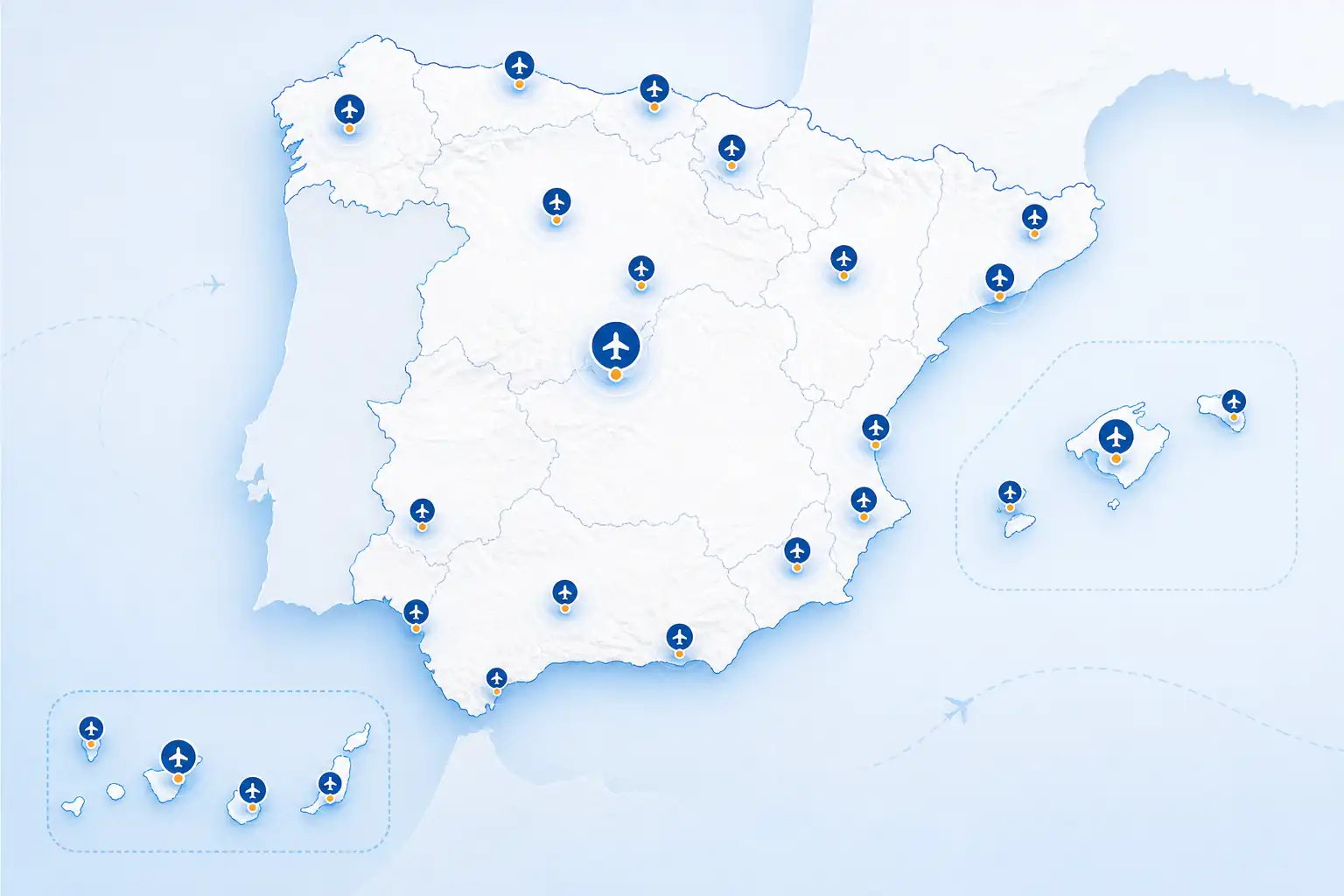
Spain has airports across the mainland, the Balearic Islands, the Canary Islands, Ceuta, and Melilla. The official Aena airport directory is the most useful place to confirm the exact airport name, code, terminal information, and live passenger services before departure.
The network is easier to understand when you group airports by the role they play in a trip:
Airport role | Typical examples | Best use |
|---|---|---|
Major international hubs | Madrid (MAD), Barcelona (BCN) | Long-haul arrivals, broad connections, multi-city routes |
Mediterranean gateways | Málaga (AGP), Alicante (ALC), Valencia (VLC) | Beach regions, city breaks, southern and eastern Spain |
Regional city airports | Seville (SVQ), Bilbao (BIO), Santiago (SCQ), Asturias (OVD) | Direct access to one region without a central-hub detour |
Island gateways | Palma (PMI), Ibiza (IBZ), Gran Canaria (LPA), Tenerife South (TFS) | Resort stays, island touring, winter sun |
A smaller regional airport may have fewer daily flights, yet it can still be the better choice if it avoids several hours of ground travel. Compare the entire door-to-door journey, not only the airfare.
Major Airports Most Travelers Use
Aena’s 2025 traffic figures place Madrid, Barcelona, Palma de Mallorca, Málaga, and Alicante among Spain’s busiest passenger airports. Their size usually means more route choice, but each serves a different travel pattern.
1. Madrid-Barajas (MAD)
Madrid is Spain’s strongest all-round hub for long-haul travel, domestic connections, and central-Spain itineraries. It is particularly practical for Madrid, Toledo, Segovia, and rail-based journeys that continue to several regions.
Best for: first-time visitors combining the capital with high-speed rail. Watch for: terminal changes and long walking distances; keep a generous connection buffer when tickets are separate.
2. Barcelona-El Prat (BCN)
Barcelona is the natural gateway for the Catalan capital, the Costa Brava, and much of northeastern Spain. It also works well for travelers pairing city culture with Mediterranean beaches or continuing toward Girona and the Pyrenees.
Transfer tip: confirm whether your accommodation is easier from the airport train, metro, or bus. The fastest option depends on the exact neighborhood, not simply the city center.
3. Palma de Mallorca (PMI)
Palma is the principal air gateway to Mallorca and becomes especially busy in the summer season. It suits travelers staying anywhere on the island, although resorts far from Palma can still require a substantial bus, shuttle, or rental-car transfer.
Planning note: reserve transport early for late-night arrivals or rural stays, when public options may be limited.

4. Málaga-Costa del Sol (AGP)
Málaga is often the most convenient entry for the Costa del Sol and a strong starting point for Andalusia. It can work for Málaga city, Marbella, Nerja, and rail or road trips toward Córdoba, Granada, and Seville.
Best for: beach-and-city combinations. Mistake to avoid: assuming every Andalusian destination is nearby; check the onward travel time before booking.
5. Alicante-Elche (ALC)
Alicante serves the Costa Blanca and resort areas around Alicante province. It can be more efficient than Valencia for destinations such as Benidorm, while Valencia Airport is normally better for Valencia city and points farther north.
Good choice when: the accommodation offers a direct shuttle or you plan to rent a car for the coast.
6. Regional Gateways
Seville is convenient for western Andalusia; Bilbao for the Basque Country; Santiago for Galicia; Valencia for the central Mediterranean coast; and Tenerife South or Gran Canaria for major Canary Island resort areas.
Direct regional flights often cost a little more but can save most of a travel day.
Compare the nearest airport with the airport offering the easiest direct route.
Price the onward train, bus, ferry, or car before deciding.
Check arrival time as carefully as arrival airport.
How to Choose the Right Arrival Airport
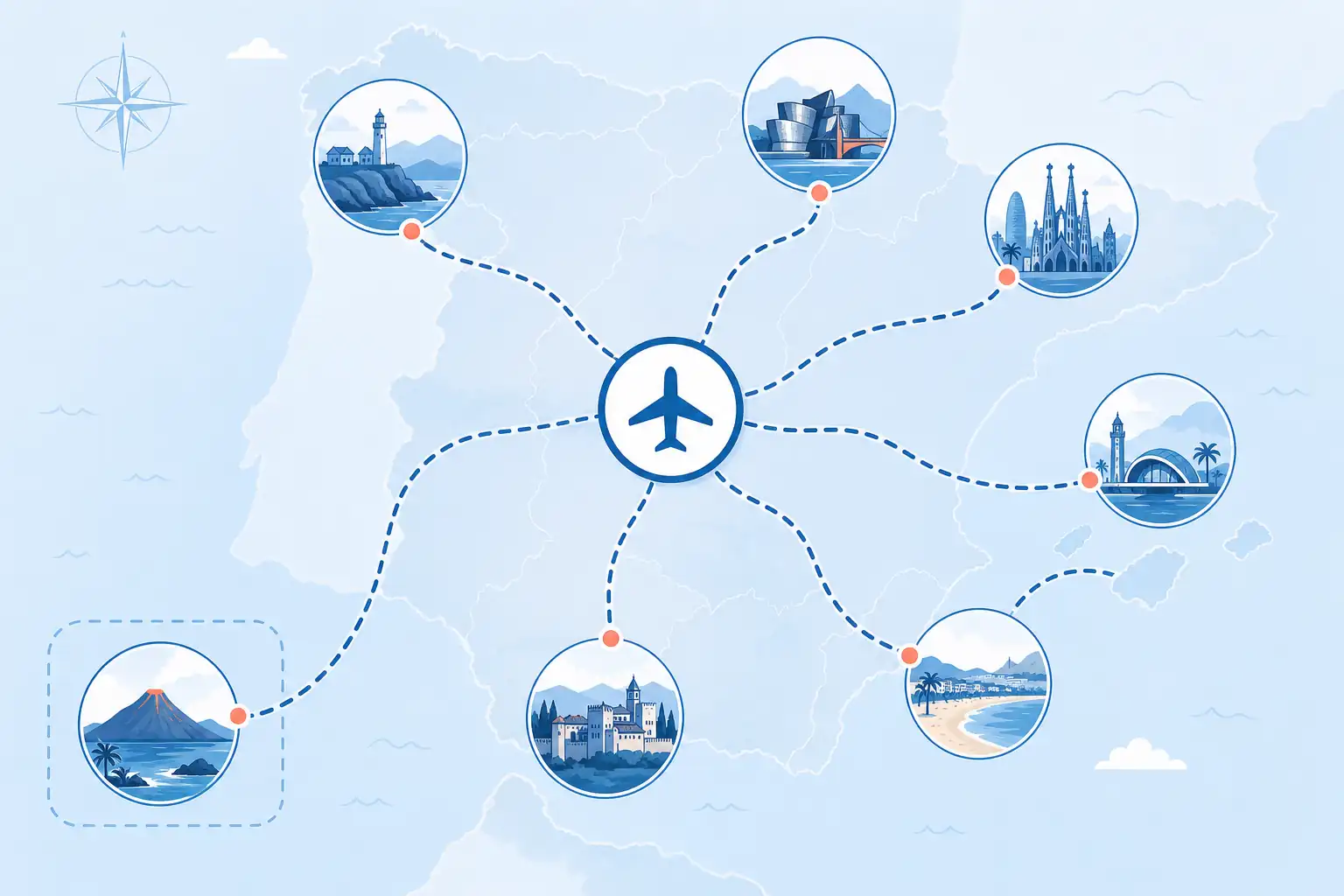
The best airport is the one that fits your route, schedule, and onward transport. Use the destination—not the flight price—as the starting point.
1. For a Single-City Break
Fly directly to that city when practical. Madrid, Barcelona, Málaga, Valencia, Seville, Bilbao, and Santiago all reward direct arrival because you can begin sightseeing without a domestic connection or long rail transfer.
2. For a Multi-City Mainland Trip
Consider an open-jaw itinerary: arrive in Madrid and depart from Barcelona, or enter through Málaga and leave from Seville. This can reduce backtracking even when the two one-way fares are slightly higher.
3. For Beaches and Resorts
Match the airport to the coast. Málaga serves the Costa del Sol; Alicante serves much of the Costa Blanca; Girona may suit the northern Costa Brava; Palma, Ibiza, Menorca, and the Canary airports serve their respective islands.
Decision rule: add airfare, baggage fees, transfer price, and transfer time. A flight that saves €30 but adds a four-hour journey is rarely the better deal.
Island Airports and Connections
Spain’s islands are well connected by air, but the arrival logic differs. The Balearics sit close to the mainland and have short flights from major Spanish cities. The Canaries are farther into the Atlantic, so the correct island airport matters even more.
Island destination | Main airport choice | Important detail |
|---|---|---|
Mallorca | Palma de Mallorca (PMI) | Allow extra transfer time for northern and eastern resorts |
Ibiza | Ibiza (IBZ) | Also used for onward ferry travel to Formentera |
Menorca | Menorca (MAH) | Useful for both Maó and Ciutadella, with different transfer times |
Tenerife | TFS or TFN | South suits many resorts; North suits La Laguna, Santa Cruz, and some inter-island routes |
Gran Canaria | Gran Canaria (LPA) | Positioned between Las Palmas and southern resort zones |
Lanzarote or Fuerteventura | ACE or FUE | Direct arrival is normally easier than changing islands after landing |
Formentera has no airport, so travelers normally fly to Ibiza and continue by ferry. In the Canaries, an inter-island flight or ferry can work well, but separate tickets need enough buffer for delays and baggage collection.
Getting from the Airport to Your Stay
Large airports often offer several transfer choices, while smaller airports may depend more heavily on buses, taxis, or rental cars. Check the last departure of the day before choosing a late flight.

1. Rail and Metro
These are often reliable for central districts in Madrid and Barcelona. They may be less convenient with bulky luggage, small children, or accommodation far from a station.
2. Airport Bus
Dedicated airport buses can be simpler than changing metro lines. They are useful when the drop-off point is close to your hotel, but traffic can make travel time variable.
3. Taxi or Prebooked Transfer
This is the easiest option for late arrivals, groups, and rural accommodation. Confirm the meeting point and use the official taxi rank or a reputable prebooked service.
4. Rental Car
A car is valuable for remote coasts and islands but unnecessary for many city-only trips. Compare terminal pickup locations, fuel policy, insurance terms, parking, and after-hours fees—not just the headline rate.

Booking and Airport Tips
A little preparation prevents the most common airport problems: unrealistic connections, surprise baggage fees, and arriving without a workable transfer.
1. Build a Real Connection Buffer
Through-tickets normally provide more protection than separate bookings. If tickets are separate, allow time to clear formalities, collect baggage, change terminals, and check in again. An overnight buffer can be sensible before a long-haul flight.
2. Check the Exact Airport Code
Some low-cost routes use airports outside the city travelers expect. Read the three-letter code and calculate the real transfer before paying.
3. Keep Travel Information Online and Offline
Download boarding passes, terminal details, transport tickets, and the hotel address. A connected phone still makes live gate alerts, maps, translation, and rebooking much easier; a travel eSIM from iRoamly can provide mobile data without depending entirely on airport Wi-Fi.
4. Pack for Security and Delays
Keep medication, essentials, a charging cable, and a change of clothes in hand luggage. Follow the current airline and airport rules for liquids, electronics, and batteries, as requirements can vary by route.
Frequently Asked Questions

1. Which airport is best for a first trip to Spain?
Madrid and Barcelona are the most flexible for international arrivals and onward travel. Choose Madrid for central Spain and broad rail connections; choose Barcelona for Catalonia and a Mediterranean-focused itinerary.
2. Can I fly into one Spanish city and out of another?
Yes. Open-jaw tickets are often ideal for Spain because the rail network connects major cities and you avoid returning to the first airport.
3. How early should I reach a Spanish airport?
Follow your airline’s current guidance. International routes, checked baggage, large hubs, and peak-season travel usually require more time than a simple domestic flight.
4. Is Madrid or Barcelona better for connecting flights?
It depends on the route and airline. Favor a single protected booking, a reasonable layover, and the airport with the fewest terminal complications.
5. Do Spain’s islands have airports?
The main Balearic and Canary islands have airports, but Formentera and Cabrera do not. Ferry travel is necessary for destinations without an airport.
6. Are airport transfers available late at night?
Taxis usually remain the most dependable late option, but public transport frequency may drop. Check the exact arrival date and time, especially on weekends or holidays.
Conclusion

Spain’s airport network gives travelers far more choice than simply Madrid or Barcelona. Regional and island gateways can place you close to the coast, a historic city, or the start of a road trip.
The most useful comparison combines fare, schedule, baggage, connection risk, and ground transport. Looking at the complete journey often reveals that the slightly more expensive flight is the easier and better-value option.
Once the airport matches the itinerary, save the transfer details, keep a realistic buffer, and arrive with both online and offline travel information ready.