
Do you need a visa to go to Spain? The answer depends mainly on your nationality, passport or travel document, trip purpose, and total time in the Schengen area. Many travelers can visit for a short stay without a visa, while others must obtain a Schengen visa before departure.
Visa-free does not mean document-free, and it does not guarantee admission. Border officers can still check passport validity, accommodation, onward travel, trip purpose, and whether you can support yourself during the stay.
This guide gives a practical decision path for tourism and other short visits, explains the main visa categories, lists common documents, and distinguishes the Entry/Exit System from the future ETIAS travel authorization.

Quick Answer: Does Spain Require a Visa?
Use the table as a starting point, then verify your exact nationality and travel document with the Spanish consulate responsible for your place of legal residence. Special passports, refugee travel documents, family-member rights, and residence permits can change the answer.
Traveler situation | Short tourism visit | What to carry or arrange |
|---|---|---|
EU, EEA, or Swiss national | No short-stay visa under free-movement rules | Valid national ID card or passport; check rules for accompanying non-EU family |
Visa-exempt non-EU national | Usually no visa for up to 90 days in any 180-day Schengen period | Valid passport and evidence supporting the trip; ETIAS when it becomes operational |
Visa-required non-EU national | Schengen visa generally required before travel | Application, passport, itinerary evidence, finances, insurance, and biometrics as required |
Traveler staying more than 90 days | Short-stay rules do not cover the trip | Appropriate Spanish national visa or residence authorization |
Traveler planning paid work | Tourist entry is not work permission | Confirm the correct work and immigration authorization before travel |
Spain applies the common Schengen short-stay framework. For non-EU nationals, the 90-day limit covers the entire Schengen area, not 90 days in Spain plus another allowance elsewhere.
Important: Check the current conditions for entry into Spain before departure. Entry rules and documentary thresholds can change.
Who Needs a Visa for Spain?

Your citizenship is the first filter, but the passport you use and any valid Schengen residence permit or long-stay visa can also matter. Do not rely only on where you live or where your flight begins.
1. EU, EEA, and Swiss Citizens
Citizens covered by European free-movement rules do not apply for a tourist visa for Spain. They should travel with a valid passport or accepted national identity card and check additional registration requirements for a longer stay.
Family note: A non-EU family member may have different document or visa requirements even when traveling with an EU citizen. Confirm the facilitated procedure rather than assuming the same rule applies.
2. Visa-Exempt Non-EU Travelers
Many nationalities, including citizens traveling on ordinary passports from countries such as the United States, Canada, the United Kingdom, Australia, New Zealand, Japan, and South Korea, can generally make short Schengen visits without a visa.
The normal limit is 90 days in any rolling 180-day period across Schengen.
Tourism, family visits, and certain limited business activities may be covered.
Paid employment is not automatically permitted.
The exact rule depends on nationality, travel document, and purpose.
Count previous stays in every Schengen country before booking a long itinerary. Exiting briefly does not automatically reset the allowance.

3. Visa-Required Non-EU Travelers
Nationals subject to the Schengen visa requirement normally need a short-stay visa before boarding. Apply through Spain when Spain is the sole destination or main destination; if no main destination exists, the first-entry rule may help determine the competent consulate.
Do not guess: Use the current official nationality list and the Spanish consulate serving your legal residence. An airline, travel agent, or informal forum cannot issue a binding immigration decision.
4. Residence-Permit and Long-Stay Visa Holders
A valid residence permit or long-stay visa issued by a Schengen country may allow short travel to Spain under Schengen rules without a separate Spanish visitor visa. Validity, passport compatibility, and time limits still apply.
Carry both: Travel with the valid passport and the original residence permit or visa evidence, not only a photo on your phone.
Spain Visa Types and How to Apply
Choose the visa by purpose and duration, not by which appointment looks easiest to obtain. Applying for the wrong category can lead to delay or refusal.
1. Airport Transit Visa
An airport transit visa applies only to certain travelers passing through the international transit area of a Schengen airport. It does not authorize entry into Spain, and nationality-based exemptions can apply.
Connection warning: A route that requires changing airports, collecting baggage, or passing border control may not qualify as airside transit.
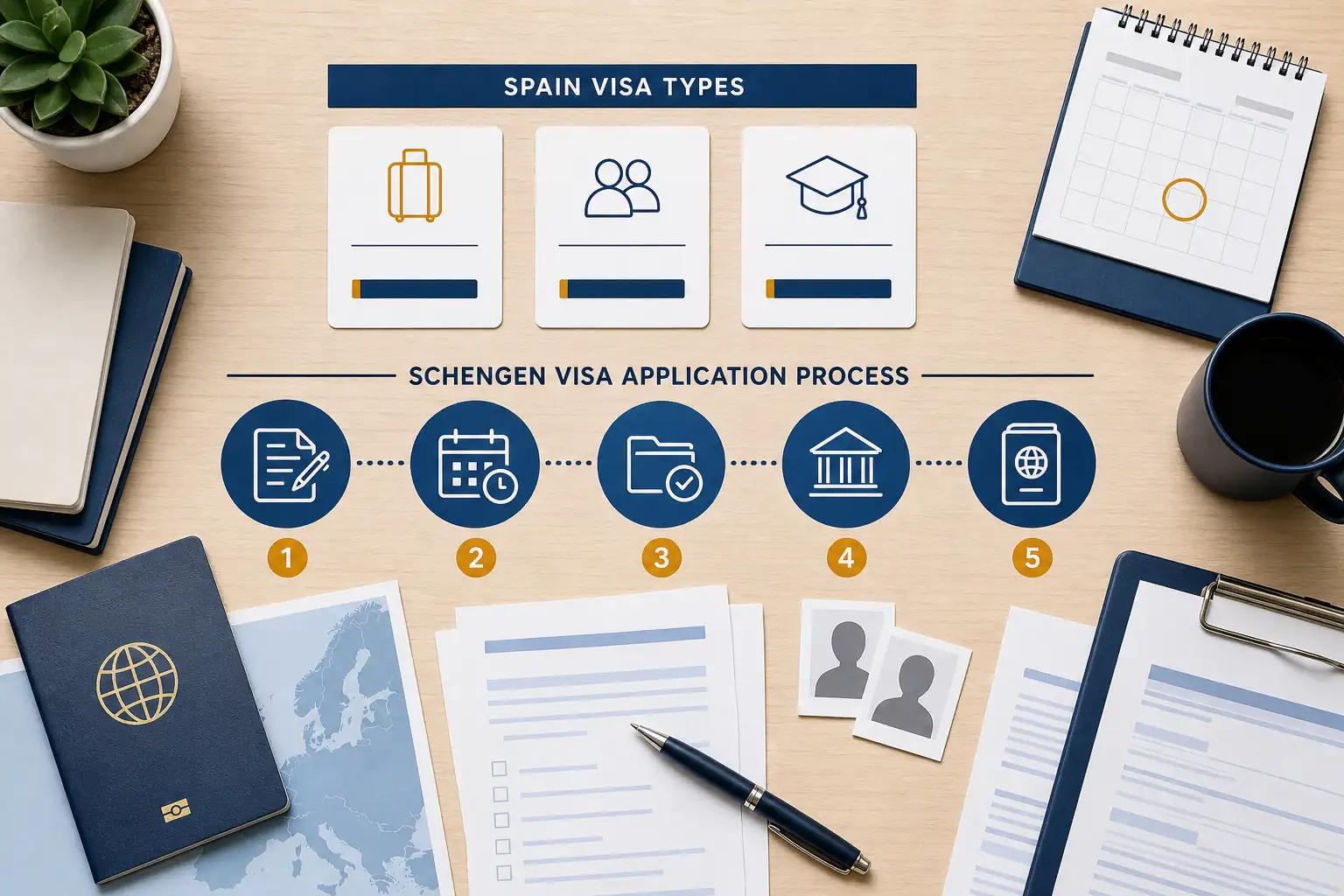
2. Schengen Short-Stay Visa
The uniform short-stay visa is used for tourism, family visits, business, and other permitted stays of up to 90 days in any 180-day period. It can be issued for one, two, or multiple entries, but the granted validity and duration control the actual trip.
Read the sticker: Check the valid-from and valid-until dates, number of entries, and authorized days as soon as the passport is returned.
3. Spanish National Visa
A national visa is generally required for stays longer than 90 days, including many work, study, family, and residence situations. Requirements differ substantially by purpose and cannot be replaced by a tourist stay.
Long-stay planning: Start with the Spanish consulate's page for the exact category because translations, legalizations, medical certificates, and criminal-record documents may take time.
4. Application Steps
Confirm the visa category and responsible Spanish consulate or authorized application center.
Book an appointment within the permitted application window.
Prepare the form and supporting evidence in the required format.
Attend in person when required, provide biometrics, and pay the applicable fee.
Track the case, respond to document requests, and inspect the issued visa before travel.
Processing time varies by case, season, and whether extra review is needed. Apply early enough to handle a request for additional evidence, but never submit through an unauthorized intermediary promising guaranteed approval.
Documents and Border Checks
A visa or visa exemption is only one part of entry. Non-EU travelers should be ready to show that their documents and itinerary satisfy the Schengen Borders Code.
1. Passport Validity
For ordinary non-EU short stays, the passport should generally be valid for at least three months after the planned departure from Schengen and have been issued within the previous ten years. Damage, missing pages, or a passport reported lost can create problems even when the expiry date looks acceptable.
Check before booking: Use the planned Schengen exit date, not the flight-to-Spain date, when testing the three-month validity margin.
2. Purpose and Accommodation
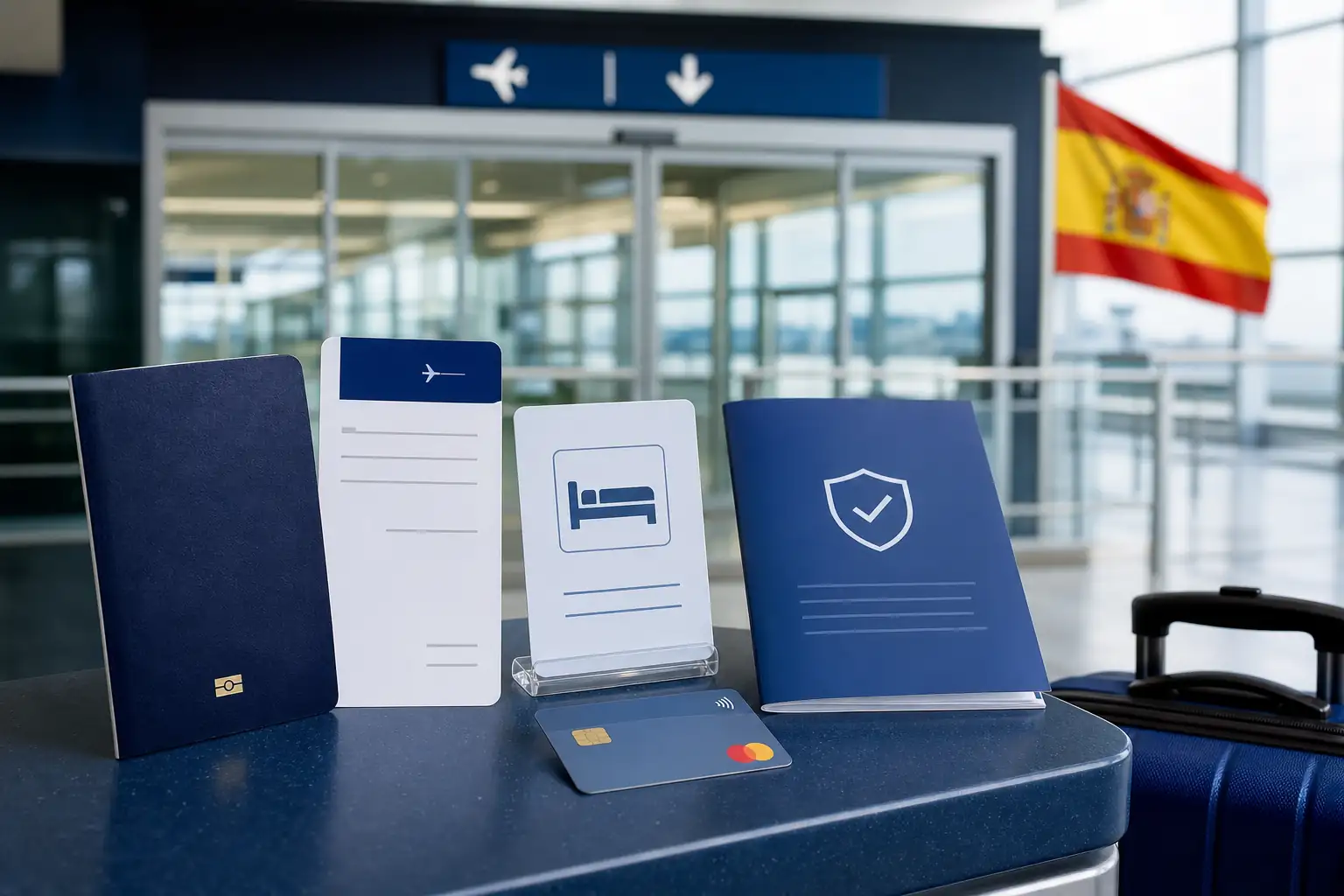
Carry hotel confirmations, an organized-tour reservation, or the appropriate invitation evidence when staying with someone. An invitation letter may prove accommodation but does not replace the other conditions of entry.
Keep the first night's address available offline.
Ensure booking names match the travelers.
Bring a clear explanation for multi-country itineraries.
3. Onward Travel and Financial Means
Border authorities may ask for a return or onward ticket and evidence of sufficient resources. Spain can update financial thresholds, so verify the current amount rather than relying on an old blog post.
Useful evidence: A combination of payment cards, recent financial records, prepaid accommodation, and a realistic itinerary is more credible than an unexplained one-way booking.
4. Insurance and Digital Backups
Schengen visa applicants normally need travel medical insurance meeting the consulate's coverage and territorial rules. Visa-exempt travelers should also consider adequate medical and disruption coverage even when it is not a formal entry requirement.
Store secure digital copies of key documents, keep originals accessible, and arrange mobile data for airline messages and booking changes. An iRoamly travel eSIM can help maintain access to reservations and contacts after landing, but it does not replace printed evidence if an officer requests it.
EES, ETIAS, and Special Situations
EES and ETIAS are different systems. EES records border crossings and biometrics for many non-EU short-stay travelers; ETIAS is a pre-travel authorization for eligible visa-exempt nationals.
1. Entry/Exit System
The EU reports that EES has been fully operational across participating Schengen countries since April 10, 2026. Covered travelers should expect digital registration and biometric procedures at external borders rather than relying solely on passport stamps.
Airport planning: Allow extra time for a first registration and follow the instructions at kiosks or staffed booths. EES does not change whether your nationality needs a visa.

2. ETIAS Timing
As of July 15, 2026, ETIAS is not yet in operation. The EU schedules it to start in the last quarter of 2026, with the specific date to be announced officially. Travelers do not need to take ETIAS action yet.
Once operational, ETIAS will apply to many visa-exempt non-EU nationals for short trips. It will be linked to the passport and will not be a visa or a guarantee of entry. Use only the official ETIAS information website and avoid lookalike application sites.
3. Minors and Family Travel
Children need their own valid travel documents and any required visa. Consent documents may be advisable or required when a minor travels with one parent, another adult, or alone, depending on the countries and carriers involved.
Family check: Confirm departure-country rules as well as Spain's entry rules, and carry documents showing parental authority where relevant.
4. Students, Workers, and Remote Work
A short visitor stay does not automatically authorize study beyond permitted short courses, local employment, or residence. Remote work can raise immigration, tax, and employment questions even when the employer is abroad.
Use the right route: Spain offers national visa and residence categories for specific purposes. Match the intended activity before travel rather than trying to convert a tourism plan informally.
Spain Visa and Entry FAQ

1. Can I visit Spain with a Schengen visa issued by another country?
Usually, a valid uniform Schengen visa can be used across the Schengen area within its conditions. You should have applied to the country that was genuinely the main destination or otherwise competent for the itinerary.
2. Does the 90-day period reset when I leave Spain?
No. It is a rolling 90 days in any 180-day period across the whole Schengen area. A short trip to a non-Schengen country does not create a new 90-day allowance.
3. Can I extend a tourist stay in Spain?
Extensions are limited to qualifying exceptional circumstances and are not a routine way to continue tourism. Contact the competent Spanish immigration or police authority before the authorized stay expires.
4. Do cruise passengers need a visa?
Possibly. Nationality, ports, whether you disembark, and the cruise route all matter. Confirm with the Spanish consulate and cruise line, but do not rely on the carrier alone for the legal requirement.
5. Can an airline deny boarding even if I think I am visa-free?
Yes. Carriers check travel documents and can refuse boarding when required evidence appears missing or inconsistent. Resolve doubts before departure and carry official proof applicable to your situation.
Conclusion

Whether you need a visa to go to Spain depends on the passport you use, the purpose and length of the trip, and your recent travel across Schengen. Begin with the nationality rule, then check passport validity and the 90-in-180 calculation.
If a visa is required, apply through the correct Spanish consulate with a coherent itinerary and complete supporting evidence. If you are visa-exempt, still prepare the documents that explain your accommodation, onward travel, and ability to fund the visit.
Finally, verify EES and ETIAS developments on official EU pages shortly before travel. A careful check takes less time than resolving a document problem at check-in or the border.