
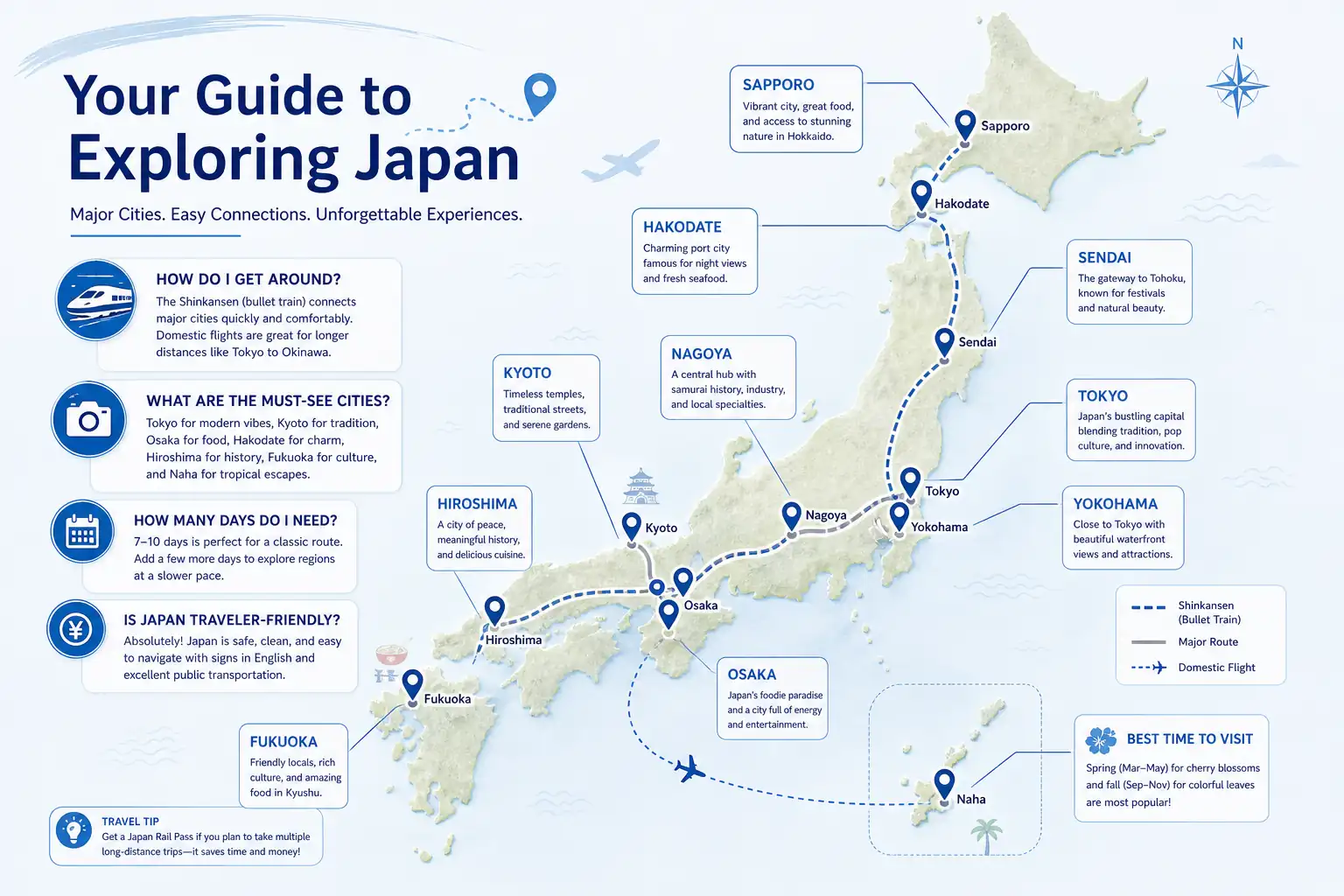
Many travelers search for a map of Japan with cities because the country can look compact at first glance. On paper, Tokyo, Kyoto, Osaka, Sapporo, Hiroshima, and Fukuoka all seem straightforward, but once you start planning trains, flights, and regional detours, the map matters a lot more than expected.
The good news is that Japan is one of the easiest countries in the world to read geographically once you break it into regions. Instead of memorizing every prefecture, it helps to understand the broad north-to-south shape of the country and the major city anchors that define each section.
This guide does exactly that. It explains how to read a map of Japan with cities for trip planning, highlights the key urban stops by region, and shows which city combinations make sense when you want an efficient route instead of a rushed one.
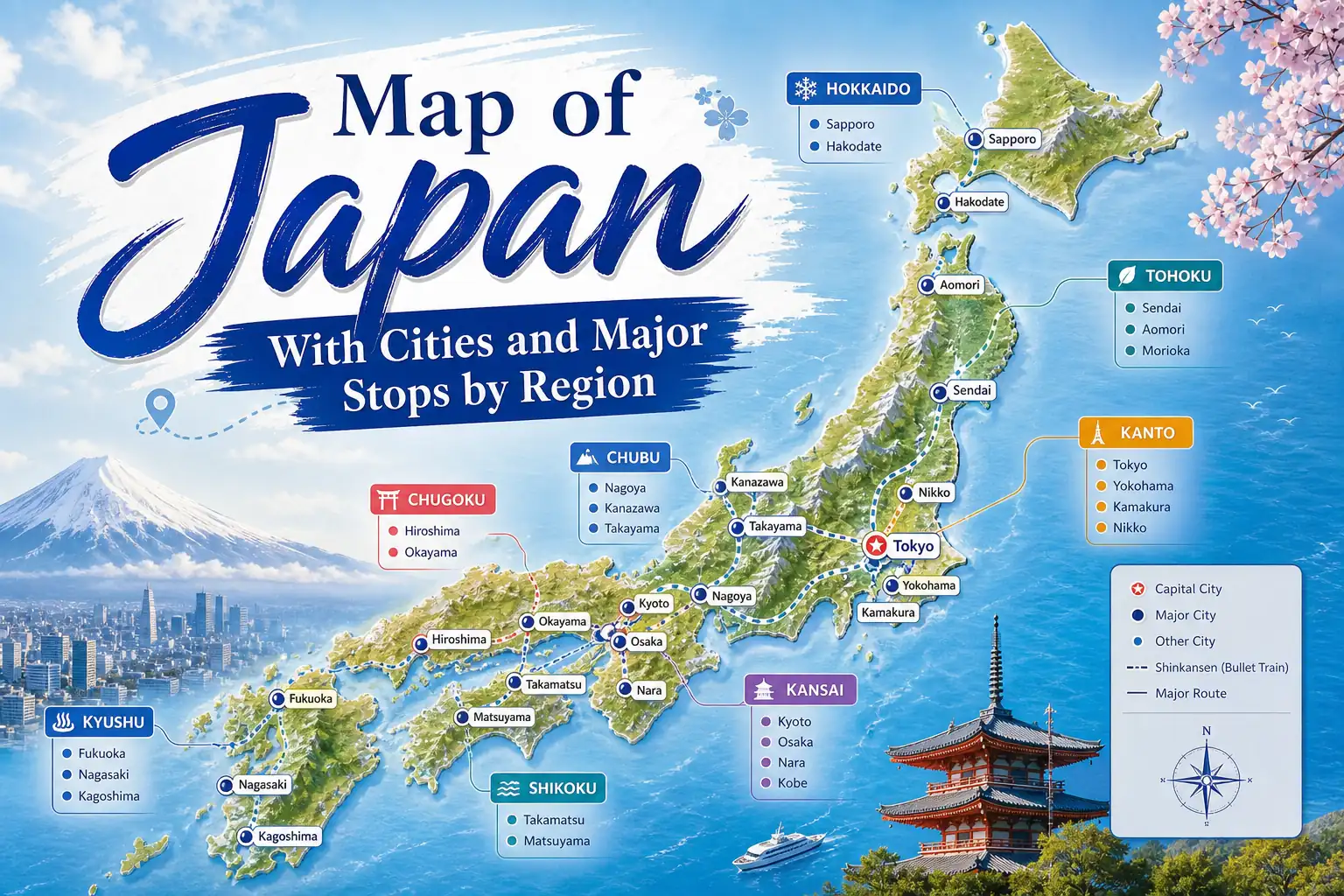
Map of Japan With Cities by Region
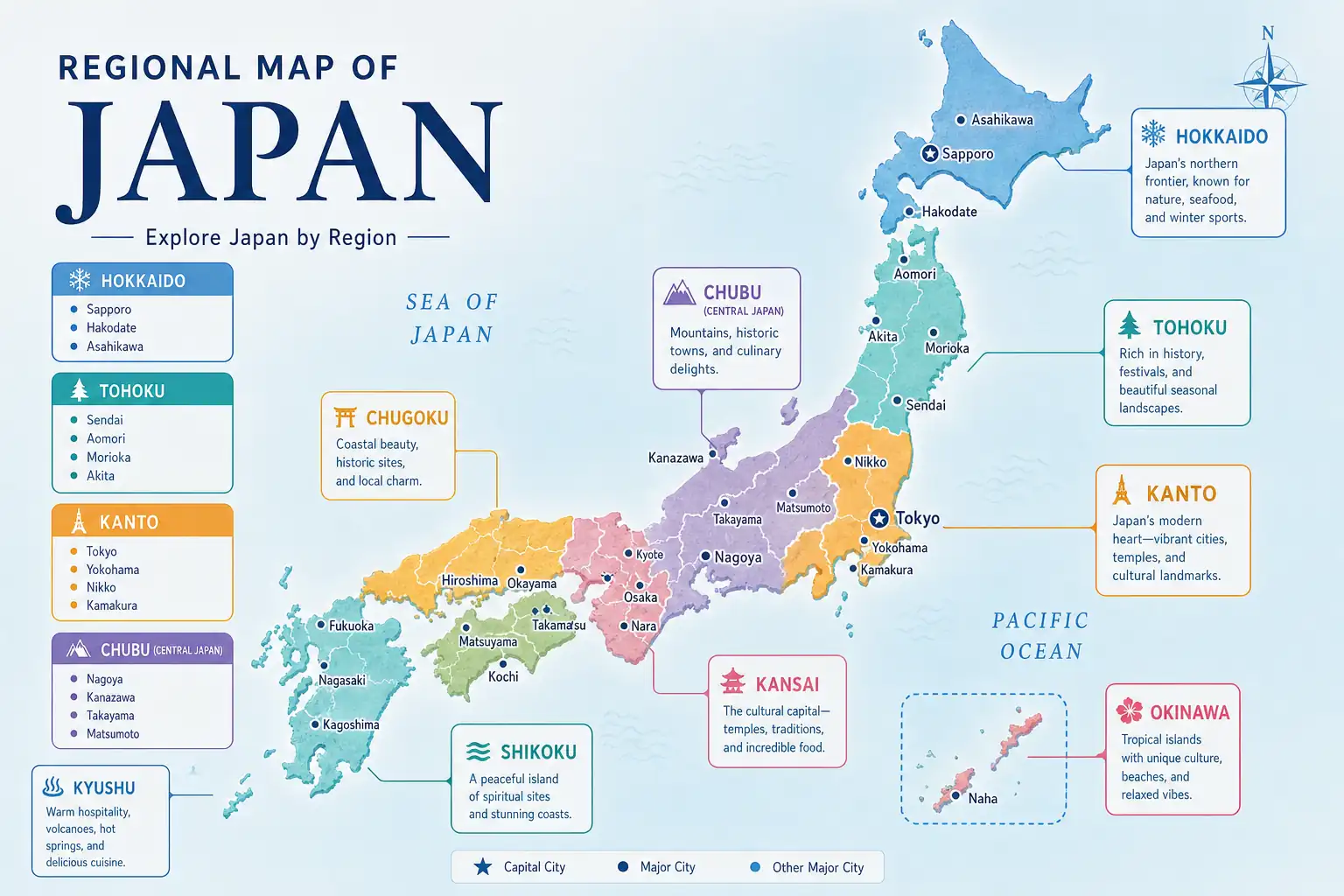
Japan stretches from Hokkaido in the north to Okinawa in the south, and official tourism planning commonly breaks the country into regional blocks. JNTO lists destinations across Hokkaido, Tohoku, Kanto, Hokuriku Shinetsu, Tokai, Kansai, Chugoku, Shikoku, Kyushu, and Okinawa, which is a helpful reminder that there is no single "standard" Japan route that fits every traveler.
For first-time planning, the easiest way to read the country is to think in connected travel zones rather than trying to understand every administrative boundary at once.
1. Hokkaido
Hokkaido sits at the top of the map and feels more spread out than many first-timers expect. Sapporo is the main city anchor for most visitors, while Hakodate, Asahikawa, and Kushiro come up depending on whether your trip leans toward food, winter scenery, nature, or wildlife.
Best fit: Snow trips, cooler summer travel, and wider landscapes.
Planning note: Travel times inside Hokkaido are longer than the map suggests, so it rewards slower itineraries.
2. Tohoku
Tohoku lies just south of Hokkaido on the main island and works well for travelers who want rural scenery, hot springs, and seasonal landscapes with fewer crowds than the classic Tokyo-Kyoto route. Sendai is the most common gateway city.
Best fit: Nature, festivals, and a quieter side of Japan.
City to note: Sendai is the easiest base if you want one urban hub with strong regional links.
3. Kanto
Kanto is where Tokyo sits, along with Yokohama, Kamakura-access corridors, and many of the first arrivals for international visitors. On a map, this is the eastern anchor of the classic first-time route.
Why it matters: Even travelers who branch out widely often use Tokyo as their transport spine.
Best fit: Big-city energy, day trips, and first-time ease.
4. Chubu, Hokuriku Shinetsu, and Tokai
This central band links mountain areas, traditional towns, and important rail corridors. Nagoya is the big transport city, while Kanazawa, Takayama, Matsumoto, and alpine areas often shape more scenic routes.
Best fit: Travelers who want variety between modern cities and slower cultural stops.
Planning note: This is where route design starts to matter most, because mountain detours can change pacing a lot.
5. Kansai
Kansai is the most important cultural cluster for many first-time visitors. Osaka, Kyoto, Nara, and Kobe sit close enough together that you can combine them without feeling overextended, which is why this section of the map is so useful for efficient rail travel.
Best fit: Food, heritage districts, temples, and easy multi-city travel.
Why travelers love it: You can change atmosphere quickly without changing hotels every night.
6. Chugoku and Shikoku
Farther west, Chugoku includes Hiroshima and Okayama, while Shikoku sits as a separate island region with a slower pace and strong coastal appeal. These are excellent choices once you want something beyond the standard first visit.
Best fit: History, islands, cycling, and scenic inland-sea routes.
Good gateway: Hiroshima is often the most straightforward entry point.
7. Kyushu and Okinawa
Kyushu is a southern region built around Fukuoka, Kumamoto, Nagasaki, Beppu, and Kagoshima, while Okinawa sits farther south with a subtropical island identity of its own. On a map, this is where Japan starts to feel much broader than a simple Tokyo-to-Kyoto line.
Best fit: Hot springs, regional food, volcanic scenery, and beach-focused add-ons.
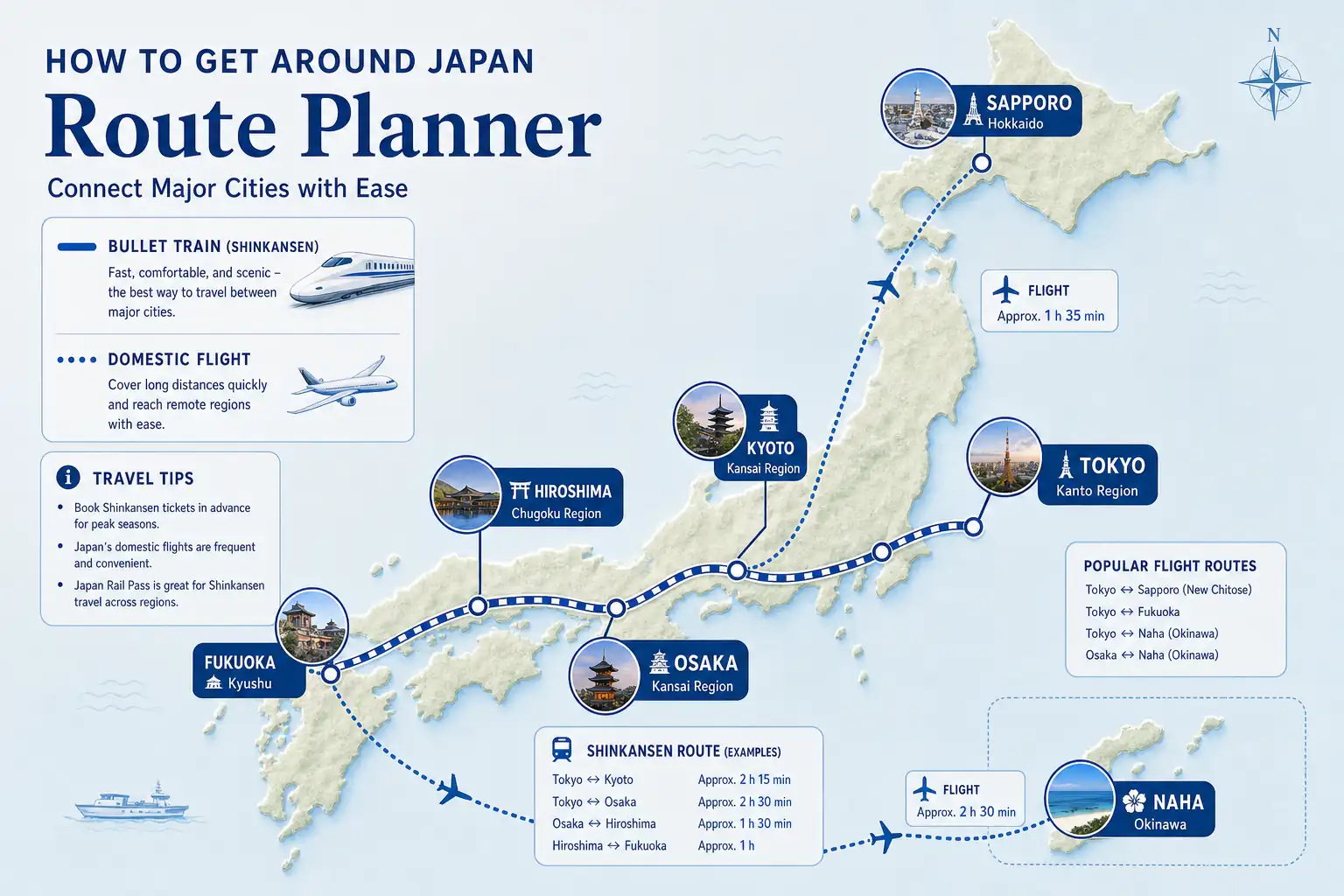
Travel note: Domestic flights become more useful the farther south your itinerary stretches.
Major Cities to Know Before You Plan a Route
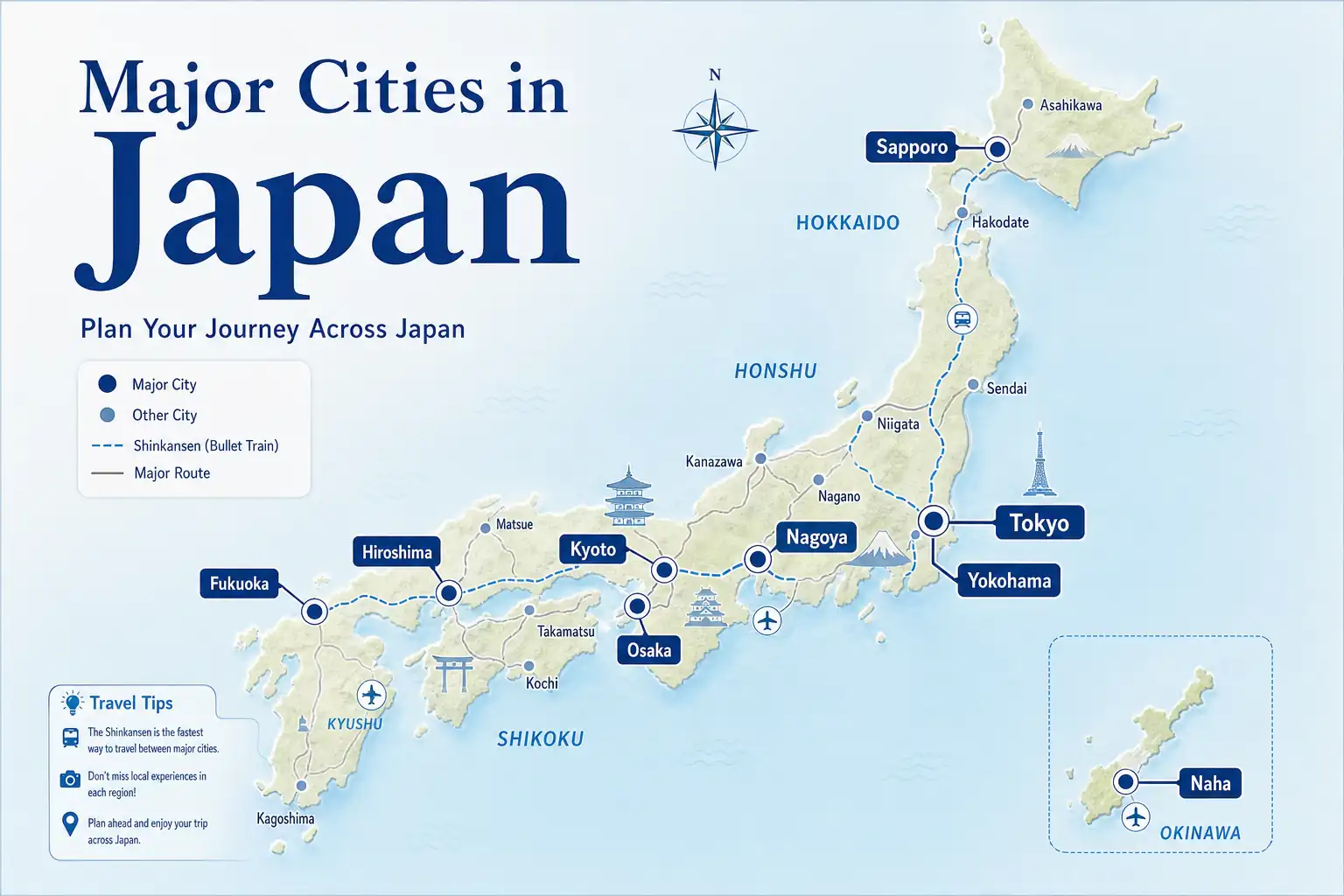
You do not need to memorize every city in Japan. You only need to recognize the ones that function as strong bases, transport hubs, or trip-shaping detours. These are the names that most often influence route planning.
1. Tokyo
Tokyo is Japan's main arrival city for many international travelers and the easiest place to start or end a trip. It works as both a destination and a transport platform.
Best for: First-time visitors, shopping, food, museums, and day trips.
Route role: Eastern anchor of many national itineraries.
2. Yokohama
Just south of Tokyo, Yokohama is easy to add without major route changes. It works well as a day trip or a softer landing after a busy Tokyo stay.
3. Nagoya
Nagoya is often overlooked, but on the map it matters because it helps connect Tokyo with Kansai and central Japan. It is practical even when it is not the emotional highlight of a trip.
4. Kyoto
Kyoto is the cultural counterweight to Tokyo. On a map, it sits in one of the easiest positions for combining temples, historic neighborhoods, and train-based side trips.
5. Osaka
Osaka is one of the strongest food and nightlife bases in the country and an efficient transport node. Many travelers prefer sleeping here while using Kyoto or Nara as day trips.
6. Nara
Nara is smaller, but it matters because it adds historic weight to a Kansai route without demanding much extra travel time.
7. Hiroshima
Hiroshima is a key western city for travelers heading beyond Kansai. It combines historical importance with access to Miyajima and onward westbound travel.
8. Fukuoka
Fukuoka is the clearest Kyushu base for most visitors. It is compact, food-focused, and useful when you want to add southern Japan without building a highly complex route.
9. Sapporo
Sapporo is the easiest Hokkaido starting point and one of the most important cities on any north-focused map reading. It shines in winter, but it also works well in milder seasons.
10. Naha
Naha matters because it signals a very different kind of Japan trip. When Okinawa enters your route, domestic flights, beach time, and climate differences change the whole map logic.
How to Use a Japan Map for Trip Planning
A map becomes genuinely useful when it helps you make faster decisions about pacing. The goal is not just knowing where cities are. It is knowing which combinations feel smooth and which ones quietly create stressful travel days.
Group your cities by region first
Start with regional clusters. Tokyo and nearby Kanto stops belong together. Kyoto, Osaka, Nara, and Kobe belong together. Hiroshima fits naturally after Kansai. Fukuoka points you into Kyushu. Once you think in clusters, the country becomes much easier to navigate.
Respect travel time even on a fast rail network
Japan's trains are excellent, but they do not erase geography. Hokkaido, Okinawa, and mountain regions still create meaningful transit time, so it is better to trim one city than to spend too much of the trip in motion.
Use digital tools while moving
Route planning changes in real time when train departures, weather, and accommodation choices shift. A travel eSIM from iRoamly helps because you can compare routes, pull up station maps, confirm reservations, and translate local place names without pausing the day to find Wi-Fi.
For official background, the JNTO destinations overview is useful for the regional picture, while JNTO's rail travel guide helps once you start linking the cities together. If you want a formal national mapping reference, GSI Maps is Japan's official geospatial map platform.
FAQ About a Map of Japan With Cities
1. What are the main cities to mark first on a map of Japan?
Tokyo, Kyoto, Osaka, Hiroshima, Fukuoka, Sapporo, and Naha are strong starting points because they shape most first-time and second-time travel routes.
2. Is Japan small enough to see many cities in one week?
You can see several cities in a week, but only if they are grouped sensibly. Tokyo plus Kansai is realistic. Tokyo, Kyoto, Osaka, Hiroshima, Fukuoka, and Sapporo in the same week usually feels rushed.
3. Which region is easiest for first-time visitors?
Kanto and Kansai are the easiest starting pair because they offer excellent transport, iconic sights, and many route options between them.
4. Should I add Hokkaido or Okinawa to a first Japan trip?
Only if you have enough time or a strong seasonal reason. Both are excellent, but each changes the map logic enough that they work better as focused additions than as quick side stops.
5. What is the best way to read the map if I want scenic travel instead of city hopping?
Look at central Japan, Tohoku, Shikoku, and Kyushu more closely. Those areas reward slower regional routes better than a checklist of major urban stops.
Final Thoughts
A map of Japan with cities becomes much more useful once you stop seeing it as a list of famous names and start seeing it as a set of travel clusters. That one shift makes itinerary planning faster and usually leads to a better-paced trip.
For most first visits, Tokyo and Kansai form the core. From there, you can decide whether your route needs a western extension to Hiroshima, a northern shift to Hokkaido, or a southern jump to Kyushu or Okinawa.
When you understand where the major cities sit and how the regions connect, Japan stops feeling complicated. The country starts to read clearly, and your route choices become much easier to make with confidence.