
Do Americans need a visa for Spain? U.S. citizens with an ordinary U.S. passport generally do not need a visa for short visits of up to 90 days in any rolling 180-day period, including tourism and limited business or study activities.
Visa-free does not mean document-free or guaranteed entry. Your passport must meet Schengen validity rules, your combined Schengen days must remain within the limit, and border officials may ask for evidence of your plans and ability to support the trip.
This guide separates short visits from long stays, explains the 90/180-day calculation, covers passport and supporting documents, and clarifies the approaching ETIAS travel-authorization requirement.

Short Answer for U.S. Citizens
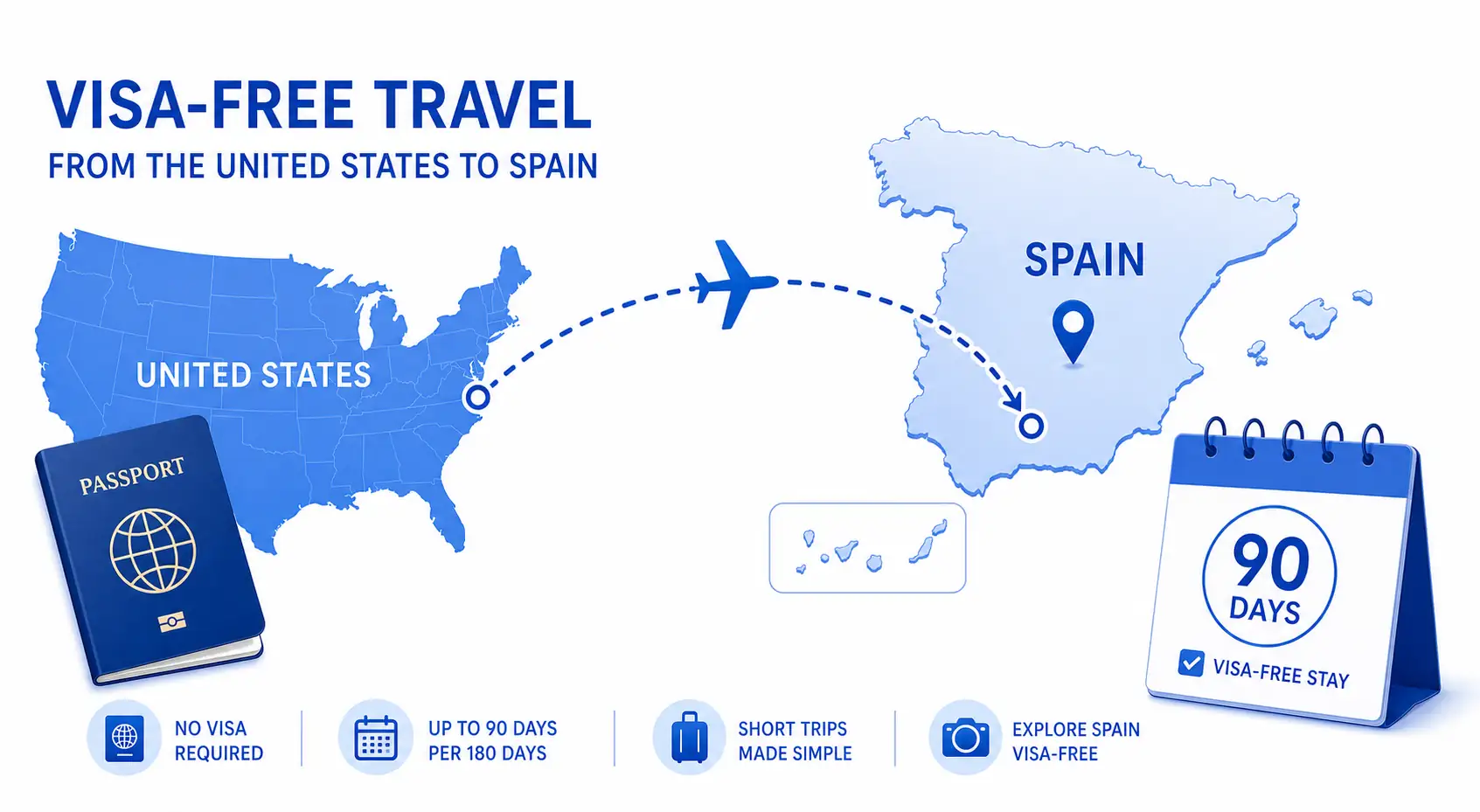
For a typical vacation, family visit, conference, short business trip, sports event, or short course, an American traveler can normally enter Spain without first obtaining a Schengen visa. The maximum visa-free stay is 90 days across the entire Schengen area during any 180-day period.
Spain's official entry conditions for U.S. citizens should be rechecked close to departure because immigration rules can change.
Travel plan | Visa position | Main caution |
|---|---|---|
Vacation under 90 days | No visa normally required | Days in all Schengen countries count together |
Short business visit | No visa normally required | Employment in Spain is different |
Short study stay | No visa normally required for up to 90 days | Confirm requirements with the program |
Stay longer than 90 days | National visa generally required | Apply before travel |
Work or residence | Appropriate authorization required | Visa-free entry does not authorize work |
Key distinction: nationality controls whether a short-stay visa is required, while the purpose and duration of the trip determine whether a national visa or other authorization is needed.
Entry Documents to Prepare

An American traveler still has to meet the Schengen Borders Code conditions at the border. Prepare the core documents before check-in rather than assuming a valid passport alone answers every question.
Passport Validity
Your passport should be valid for at least three months after the date you intend to leave the Schengen area, and it must have been issued within the previous 10 years on the day of entry. Airlines or itineraries may create practical complications when validity is close to the minimum, so renewing earlier can reduce risk.
Check the issue date as well as the expiration date.
Make sure the passport is undamaged and has usable space for border processing.
Each child needs an individual passport.
Keep a secure digital copy separate from the original.
Proof of the Trip
Border authorities may ask about your destination, accommodation, return or onward travel, and sufficient financial means. A tidy digital folder makes these easy to show without searching through email at the inspection desk.
Round-trip or onward ticket confirmation.
Hotel bookings, rental details, or an invitation document when relevant.
Travel itinerary and contact details for the first accommodation.
Evidence that you can fund the stay and return journey.
A visa exemption permits travel to the border; it does not create an unconditional right of entry.
How the 90/180-Day Rule Works
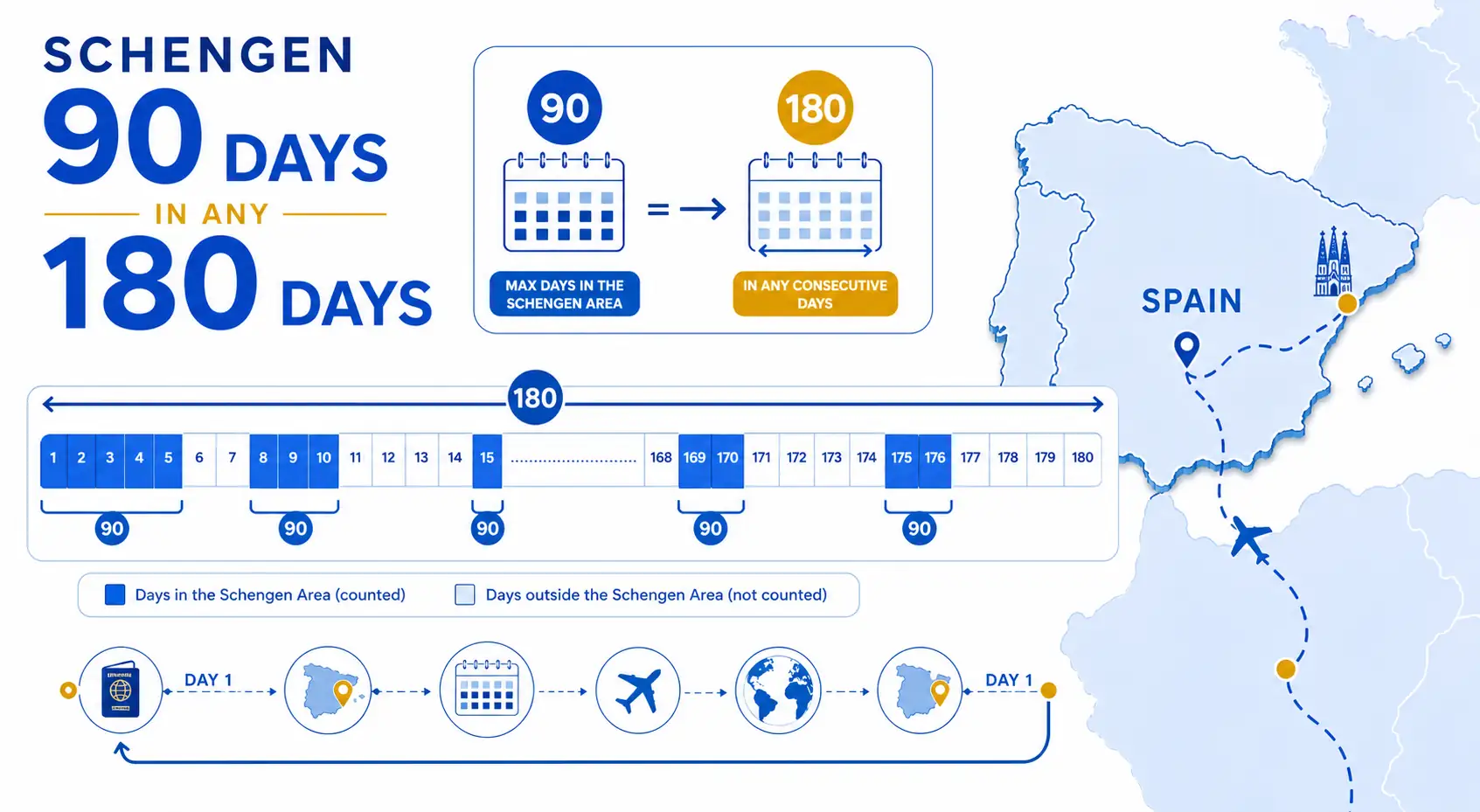
The limit is not 90 days per country, 90 days per calendar year, or an automatic reset after leaving Spain. On each day of a proposed stay, look back over the preceding 180 days and count every day spent anywhere in the Schengen area.
Count Entry and Exit Days
Both the day you enter and the day you leave normally count as days of presence. A journey through Spain, France, Italy, and Portugal therefore uses one shared Schengen allowance rather than four separate national allowances.
Use a Rolling Window
Older travel days gradually fall outside the 180-day window. That can release days for a later visit, but a weekend outside Schengen does not reset the whole allowance.
Example | How it affects the allowance |
|---|---|
30 days in Spain | Uses 30 Schengen days |
20 more days in France | Total becomes 50 Schengen days |
Trip to the United Kingdom | Does not use Schengen days, but does not reset prior days |
Return to Spain | Only remaining days within the rolling calculation are available |
Planning tip: Use the European Commission's short-stay calculator or count travel days in a spreadsheet when you have several trips. Leave a buffer for flight disruption rather than planning to depart on the final possible day.
When Americans Need a Visa
A national visa is generally required before travel when the planned stay exceeds 90 days, involves residence, or includes activities not covered by short visa-free admission. The exact category depends on what you will do in Spain, not simply how long you would like to remain.

Long-Term Study
A program lasting more than 90 days normally requires the appropriate study visa. Application documents can include enrollment evidence, financial means, insurance, and additional records depending on duration and the applicant's circumstances.
Employment or Professional Activity
Working for a Spanish employer, carrying out regulated employment, or moving for a professional assignment can require advance authorization and a work-related visa. A short business meeting is not the same as entering the Spanish labor market.
Residence, Family, or Remote Work
Spain has national visa routes for residence, family circumstances, remote work, and other defined situations. Each has its own eligibility and documentation; do not enter as a tourist intending to solve the status after arrival unless an official procedure specifically permits it.
Identify the correct visa category before booking a nonrefundable long stay.
Use the Spanish consulate responsible for your place of residence.
Allow time for apostilles, translations, background checks, or medical documents when requested.
Follow the validity dates and post-arrival registration steps shown on the approval.
Common mistake: Do not assume that owning property, renting an apartment, or working online automatically grants a right to live in Spain.
ETIAS and Pre-Departure Planning
As of July 15, 2026, ETIAS is not yet operating and travelers do not need to apply. The European Union currently says the system will begin in the last quarter of 2026 and will announce the specific start date before launch.
What ETIAS Will Change
Once active, ETIAS will be a travel authorization for visa-exempt travelers, linked electronically to the passport. It will not be a visa and will not extend the 90/180-day limit. Check the official ETIAS launch information rather than paying an unofficial site before applications open.

Check the Whole Route
If your itinerary includes another Schengen country before Spain, you complete external-border processing there. Transit through a non-Schengen country can have separate document or authorization rules, even when Spain itself is visa-free.
Keep Essential Details Online
Mobile data helps you retrieve bookings, message a host, open maps, and receive airline updates. An iRoamly travel eSIM is one connectivity option for an unlocked, compatible phone; install it before departure and keep activation instructions available offline.
Recheck passport validity and prior Schengen travel.
Save tickets, accommodation, insurance, and visa documents offline.
Confirm requirements again shortly before departure.
Carry details for the first night's accommodation.
Spain Visa FAQ for Americans

1. Can I spend 90 days in Spain and then 90 in Italy?
No. Spain and Italy are both in Schengen, so the combined stay cannot exceed 90 days in any rolling 180-day period unless you hold an authorization that changes your status.
2. Can I work remotely during a tourist visit?
A brief work-related task while traveling is different from relocating to work from Spain. If remote work is a central purpose or the stay is extended, obtain professional advice and assess the appropriate Spanish visa route.
3. Do green-card holders follow the same visa rule?
Visa requirements follow nationality, not U.S. residence. A green-card holder who is not a U.S. citizen must check the rule for the passport they will use.
4. Does a cruise stop in Spain count as a Schengen day?
It can count when you are admitted into the Schengen area. Cruise routes can cross external borders several times, so confirm the sequence with the cruise operator and count conservatively.
5. Is travel insurance required for visa-free Americans?
It is generally not a standard visa-free entry document in the way it is for many visa applications, but coverage is strongly worth considering because U.S. health insurance may provide limited protection abroad.
6. What if my passport expires shortly after the trip?
If it will not remain valid for at least three months after your planned Schengen departure, renew it before travel. Also verify that it was issued within the previous 10 years.
Conclusion

Most Americans visiting Spain for a normal short trip do not need a visa, provided the combined Schengen stay remains within 90 days in any 180-day period and the travel purpose fits visa-free admission.
The practical work is checking passport dates, counting previous Schengen days, and keeping evidence of transport, accommodation, and funds available. Travelers planning to work, live, or stay longer should choose the correct national visa before departure.
Because entry systems are changing, check the Spanish authorities and the official ETIAS site again near your travel date. A final document review is a small step that can prevent a large disruption at the airport.